by OB/GYN | Sep 24, 2021 | OB/GYN News
[vc_row][vc_column][vc_column_text]Topic: Examining the Role of Ultrasound Imaging in Prenatal Care
Ultrasound imaging plays an important role in prenatal care. However, some surprising new evidence has emerged from researchers, ultimately revealing some disparities and the fact that not every patient is receiving the same type of care as another patient.
Disparities in Prenatal Care
Disparities in prenatal care were made evident after researchers examined more than 80,000 pregnancies. These disparities were particularly noticeable in low-income neighborhoods, rural or remote areas, and among indigenous peoples.
More specifically, the aforementioned groups were less likely to receive an exam during their second trimester, which is heavily recommended by experts, according to Academic Radiology. Researchers attributed such disparities to possible barriers in accessing ultrasound imaging, which is a crucial part of prenatal care during pregnancy.
Scott J. Adams, MD, with the Department of Medical Imaging at the University of Saskatchewan in Canada, along with his co-authors, hoped the study would remedy inequities in prenatal care, expanding access to ultrasound imaging for pregnant women.
A Study in Ultrasound Equity
The study took place in Saskatchewan, Canada from 2014-2018. In essence, Adams and other researchers analyzed 57,881 pregnant women who had a United States prenatal exam performed. The results revealed that during 88.4% of the pregnancies studied, at least one ultrasound was rendered. In addition, 3.3 prenatal exams were performed on average per pregnant mother.
Of the 57,881 pregnant women, 57,186 of those pregnancies made it to 23 weeks or longer. Furthermore, 50,180 of those women received an ultrasound during their second trimester (approximately 87.7%).
Disparities became further evident when the data was further broken down. A higher income, along with older age, at-risk pregnancies, and comorbidities rendered a higher rate of prenatal exams. In fact, pregnant women who lived in the highest income areas were more likely to receive an ultrasound in their second trimester by approximately 86% as compared to those in lower-income areas.
Ultimately, Adams and the other researchers proposed several ways to help close disparities in prenatal care and ultrasound imaging, including the utilization of telerobotic ultrasound in areas that were remote or rural. Due to the coronavirus pandemic, this method was quite successful. The aim of the study, as noted by researchers, is to create innovative solutions so that there is equal access to prenatal care and ultrasound imaging.
Key Takeaway
One study revealed disparities in prenatal care, especially in terms of receiving an ultrasound during the second trimester. It is the researchers’ hope that these findings will spur medical institutions and organizations to further action to close these inequities, providing equal prenatal care to all.
Topic Discussed: Examining the Role of Ultrasound Imaging in Prenatal Care[/vc_column_text][/vc_column][/vc_row][vc_row css=”.vc_custom_1618658856512{margin-top: 75px !important;}”][vc_column][vc_text_separator title=”Services We Offer:”][vc_column_text]
Laparoscopy | Abnormal Bleeding | Menopause | Minimally Invasive Surgery | Contraception | Pap Smear | Pelvic Pain | Family Planning | STD Testing | Hormone Therapy | Hysterectomy | Infertility | 3D Mammography | Pregnancy & Prenatal Care | Preventive Screening
[/vc_column_text][vc_text_separator title=”Website Navigation:”][vc_column_text]
Home | About | OB Videos | Insurances Accepted | Blog | Providers | Michael Anthony, MD, FACOG | Noemi Maydew, MD, FACOG | Anne Bond Bonpain, MD, FACOG | Elita Wyckoff, MD, FACOG | Gilberto Rodrigo, MD, FACOG | Jennifer Fraley, MD, FACOG | Heather Flowers | Courtney Braswell | Services | Patient Care | Advanced Care Team | Testimonials | Contact Us | Patient Portal
[/vc_column_text][/vc_column][/vc_row]

by OB/GYN | Sep 22, 2021 | OB/GYN News
[vc_row][vc_column][vc_column_text]Topic: Why Aren’t STD Screening Guidelines the Same For Men and Women?
Sexually transmitted diseases (STDs) have been rising periodically for the last several years, and experts say the importance of screening is rising with it.
Cases of STDs reached an all-time high in 2019, with 2.5 million cases of chlamydia, gonorrhea, and syphilis reported. according to data from the Centers for Disease Control (CDC).
Health authorities worry that this trend will continue in 2020 and 2021 as the COVID-19 pandemic disrupted access to in-person STD testing and treatment services.
“People don’t stop having sex in a pandemic,” Jennifer Lincoln, MD, an OB-GYN in Portland, Oregon, tells Verywell. “People might have been too afraid to go out to get condoms. Or they would have gone to their primary care doc and gotten tested if they had a new partner, but they didn’t because offices were closed and we were doing telehealth.”
Telehealth has amazing benefits, Lincoln adds, but “for the most part, you can’t collect a urine swab or a vaginal swab over the phone.”
The U.S. Preventive Services Task Force (USPSTF) recently reiterated its recommendations for chlamydia and gonorrhea screening in all sexually active women under 24 and those aged 25 and above who are at “increased risk for infection.”
The recommendations remain largely the same as the 2014 guidelines. But the task force found “insufficient evidence to assess the benefits and harms” of chlamydia and gonorrhea screening in men.
Lincoln says that men who have gonorrhea may be more likely to show symptoms than women, who are often asymptomatic, which could be one of the reasons the task force decided not to recommend screening in men.
“It’s a little silly, because where do we think the majority of women get chlamydia and gonorrhea from?” Lincoln says. “You can have same sex transmission, absolutely. But the vast majority [of women] are getting them from somebody who has a penis.”
She adds that men could unknowingly pass the infection to women they have sex with, even if they tend to have more noticeable symptoms.
The situation is similar to the administering of human papillomavirus (HPV) vaccines, Lincoln explains. A CDC advisory panel has recommended catch-up HPV vaccinations for women aged 26 and under since 2006. The same catch-up vaccinations have only been recommended for men who are 21 years old or younger since 2011.
The guidance was eventually changed in 2019 to recommend catch-up HPV vaccines for all genders aged 26 and under.
Lincoln says she supports using studies and data in making medical recommendations, but the data needed to make the recommendation for chlamydia and gonorrhea screening in men may already be available.
“I’m also a huge fan of common sense,” Lincoln says. “If you want to stop very common infections like chlamydia and gonorrhea, it takes two to tango.”
Topic Discussed: Why Aren’t STD Screening Guidelines the Same For Men and Women?
Read More[/vc_column_text][/vc_column][/vc_row][vc_row css=”.vc_custom_1618658856512{margin-top: 75px !important;}”][vc_column][vc_text_separator title=”Services We Offer:”][vc_column_text]
Laparoscopy | Abnormal Bleeding | Menopause | Minimally Invasive Surgery | Contraception | Pap Smear | Pelvic Pain | Family Planning | STD Testing | Hormone Therapy | Hysterectomy | Infertility | 3D Mammography | Pregnancy & Prenatal Care | Preventive Screening
[/vc_column_text][vc_text_separator title=”Website Navigation:”][vc_column_text]
Home | About | OB Videos | Insurances Accepted | Blog | Providers | Michael Anthony, MD, FACOG | Noemi Maydew, MD, FACOG | Anne Bond Bonpain, MD, FACOG | Elita Wyckoff, MD, FACOG | Gilberto Rodrigo, MD, FACOG | Jennifer Fraley, MD, FACOG | Heather Flowers | Courtney Braswell | Services | Patient Care | Advanced Care Team | Testimonials | Contact Us | Patient Portal
[/vc_column_text][/vc_column][/vc_row]
by OB/GYN | Sep 20, 2021 | OB/GYN News
[vc_row][vc_column][vc_column_text]Topic: Research breakthrough could protect against breast cancer progression
Leading scientists have identified a possible link between antibiotic use and the speed of breast cancer growth in mice, and identified a type of immune cell that could be targeted to reverse it.
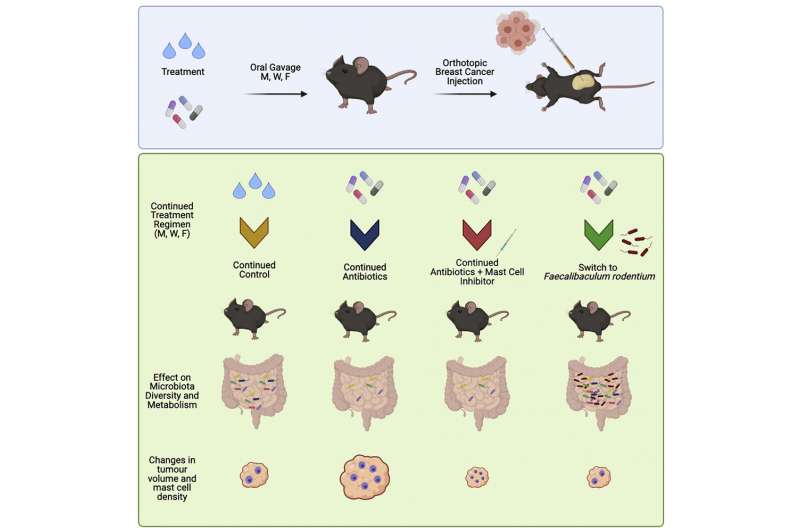
In a new study funded by Breast Cancer Now, researchers from UEA and the Quadram Institute found that treating mice with broad-spectrum antibiotics increased the rate at which breast cancer tumors grew in them.
They also observed an increase in the size of secondary tumors that grew in other organs when the cancer spread.
Led by Dr. Stephen Robinson, Group Leader at the Quadram Institute and Research Leader at UEA, the team used a cocktail of five antibiotics, and broad-spectrum antibiotic cefalexin on its own, to investigate how disrupting a healthy balance of bacteria in the gut affected breast cancer growth in mice.
The researchers discovered that the use of antibiotics led to the loss of a beneficial bacterial species, which in turn sped up tumor growth.
Through further investigation, the team also found that a type of immune cell, known as mast cells, were found in larger numbers in breast cancer tumors in mice treated with antibiotics. Blocking the function of these cells also reversed the effect of antibiotics and reduced the aggressive growth of the tumors.
It is hoped that these results could lead to a refinement of antibiotic use in people affected by breast cancer, and the development of new ways to counteract the negative effects that certain antibiotics could have on breast cancer.
This is important as while chemotherapy is a cornerstone of breast cancer treatment it reduces the number of white blood cells in the blood, making people more susceptible to infection. Antibiotics are therefore often prescribed to breast cancer patients to control any infections that arise during chemotherapy treatment.
Dr. Stephen Robinson, Group Leader at the Quadram Institute and Research Leader at UEA’s School of Biological Sciences, said: “With the rise in bacteria resistance to antibiotics we have known for many years that we need to be very careful about clinical antibiotic use.
Topic Discussed: Research breakthrough could protect against breast cancer progression
Read More[/vc_column_text][/vc_column][/vc_row][vc_row css=”.vc_custom_1618658856512{margin-top: 75px !important;}”][vc_column][vc_text_separator title=”Services We Offer:”][vc_column_text]
Laparoscopy | Abnormal Bleeding | Menopause | Minimally Invasive Surgery | Contraception | Pap Smear | Pelvic Pain | Family Planning | STD Testing | Hormone Therapy | Hysterectomy | Infertility | 3D Mammography | Pregnancy & Prenatal Care | Preventive Screening
[/vc_column_text][vc_text_separator title=”Website Navigation:”][vc_column_text]
Home | About | OB Videos | Insurances Accepted | Blog | Providers | Michael Anthony, MD, FACOG | Noemi Maydew, MD, FACOG | Anne Bond Bonpain, MD, FACOG | Elita Wyckoff, MD, FACOG | Gilberto Rodrigo, MD, FACOG | Jennifer Fraley, MD, FACOG | Heather Flowers | Courtney Braswell | Services | Patient Care | Advanced Care Team | Testimonials | Contact Us | Patient Portal
[/vc_column_text][/vc_column][/vc_row]

by OB/GYN | Sep 15, 2021 | OB/GYN News
[vc_row][vc_column][vc_column_text]Topic: Why extreme heat can hurt expectant moms, prompt early pregnancy and infant death
California and several western states just experienced their hottest summer on record, and this issue will likely worsen with climate change.
Although the human body can tolerate heat well, extreme temperatures become a concern the older someone gets. That’s because the cardiovascular system deteriorates as it ages, according to Alan Barreca, an associate professor at the UCLA Institute of the Environment and Sustainability.
Regions like LA are equipped to handle heat due to the large presence of air conditioning, but Barreca says heat-related deaths still occur.
But other areas are unaccustomed to extreme weather, like the Pacific Northwest.
“We see thousands of deaths every year in the United States from extreme heat. But it’s thought that that number would be four times higher if we didn’t have access to air conditioning,” he tells KCRW.
Christine James, an allergist-immunologist at UC San Diego Health, wrote an essay about her experiences as an expectant mother and how heat impacts moms.
“It’s pretty incredible to see how the risk of things like preterm birth and stillbirth rise when you’re exposed to extreme heat, and especially for mothers of color, Black, pregnant individuals who are already susceptible to higher rates of preterm births, low birth weight, and stillbirth. Their risk, because of their exposure to excessive heat, is even more increased,” she explains.
Barreca and a team of researchers explored the connection between early pregnancies and heat, and found that on days when temperatures exceed 90 degrees Fahrenheit, birth rates increased. He says that’s due in part to higher oxytocin levels in expectant moms.
“Oxytocin is known as this love hormone. But it also is important for regulating delivery,” Barreca says. “If you look out over the next time period … we actually see that births fall … up to about two weeks later. And so what this temporal pattern is illustrating is that some women are delivering up to two weeks early.”
He points out that early-term pregnancy is especially harmful for infant health, and can even cause asthma or even infant death.
Topic Discussed: Why extreme heat can hurt expectant moms, prompt early pregnancy and infant death
Read More[/vc_column_text][/vc_column][/vc_row][vc_row css=”.vc_custom_1618658856512{margin-top: 75px !important;}”][vc_column][vc_text_separator title=”Services We Offer:”][vc_column_text]
Laparoscopy | Abnormal Bleeding | Menopause | Minimally Invasive Surgery | Contraception | Pap Smear | Pelvic Pain | Family Planning | STD Testing | Hormone Therapy | Hysterectomy | Infertility | 3D Mammography | Pregnancy & Prenatal Care | Preventive Screening
[/vc_column_text][vc_text_separator title=”Website Navigation:”][vc_column_text]
Home | About | OB Videos | Insurances Accepted | Blog | Providers | Michael Anthony, MD, FACOG | Noemi Maydew, MD, FACOG | Anne Bond Bonpain, MD, FACOG | Elita Wyckoff, MD, FACOG | Gilberto Rodrigo, MD, FACOG | Jennifer Fraley, MD, FACOG | Heather Flowers | Courtney Braswell | Services | Patient Care | Advanced Care Team | Testimonials | Contact Us | Patient Portal
[/vc_column_text][/vc_column][/vc_row]

by OB/GYN | Sep 13, 2021 | OB/GYN News
[vc_row][vc_column][vc_column_text]Topic: The life-saving benefits of kangaroo care
A method of caring for premature newborns by swaddling them against their mother’s skin is reducing pressure on incubators, but has also been found to bring other benefits too.
Ojoma Ekhomun knew the birth of her first child was going to be difficult – just as she went for her six-month check-up and scan, Nigeria went into lockdown. What she did not expect at that appointment in March, was to find herself back at the hospital less than a month later going into labour just 31 weeks into her pregnancy.
Her tiny, premature son weighed just 1lb 8oz (700g) when he was delivered through caesarean section. He was underdeveloped and his low weight made him extremely vulnerable. According to doctors, the baby boy – named Akahomhen – was the smallest child to have been cared for at the Amuwo Odofin Maternal and Child Centre in Lagos, where he was transferred immediately after being born.
In the days that followed, Akahomhen’s weight dropped to 1lb 5oz (600g) and his doctors were concerned. Around 205 babies die in Nigeria every day as a result of being born premature – accounting for 31% of all neonatal deaths in the country.
Despite being Africa’s biggest economy, poor investment in health infrastructure, coupled with limited access to maternity services in some areas, means that neonatal mortality in the country is among the highest in the world. Rural areas in particular have high rates of maternal and newborn deaths.
Fortunately for Ekhomun’s son, the Amuwo Odofin Maternal and Child Centre is one of the more modern facilities in the country. Doctors were able to put her son into an incubator – often in short supply in Nigeria – and slowly his weight began to rise. But just as he reached 2lbs 3oz (1kg) – still a critically low weight for a newborn – they took him out.
Instead, the doctors bundled him against his mother’s chest, their naked skin pressed against each other. Ekhomun carried him like this everywhere she went over the following weeks, unwrapping him only to breast feed and to sleep.
Slowly her son began gaining weight, putting on around 1oz (30g) a day until he weighed 3lbs 15oz (1.8kg) at 60 days old. Initially he had to be fed through a syringe, but gradually he began to breastfeed. Over the following months, Ekhomun continued to carry her son swaddled next to her skin as he grew into a healthy, bouncing baby.
“He is very safe there,” says the 26-year-old mother. “I enjoy the heat between the baby and myself.”
This simple, but remarkably effective approach – known as “kangaroo care” due to the way the baby is carried on the mother’s front – is regarded as one of the best alternatives to incubators when caring for premature and low-weight babies.
“We have about 19 randomised trials from all over the world that show a reduction in deaths,” says Joy Lawn, a professor of maternal, reproductive and child health at the London School of Hygiene and Tropical Medicine in the UK. “Most of those trials have focused on babies who are already less sick. They are still preterm but they are not very ill.”
Lawn has spent over a decade researching the benefits of kangaroo care, particularly in Africa. Her research suggests kangaroo care can provide a lifeline to premature babies in rural and hard-to-reach communities where access to incubators is limited.
But she believes the approach is vastly under-used and could also be of benefit in more developed countries to ease pressure on overstretched neonatal intensive care units.
Topic Discussed: The life-saving benefits of kangaroo care
Read More[/vc_column_text][/vc_column][/vc_row][vc_row css=”.vc_custom_1618658856512{margin-top: 75px !important;}”][vc_column][vc_text_separator title=”Services We Offer:”][vc_column_text]
Laparoscopy | Abnormal Bleeding | Menopause | Minimally Invasive Surgery | Contraception | Pap Smear | Pelvic Pain | Family Planning | STD Testing | Hormone Therapy | Hysterectomy | Infertility | 3D Mammography | Pregnancy & Prenatal Care | Preventive Screening
[/vc_column_text][vc_text_separator title=”Website Navigation:”][vc_column_text]
Home | About | OB Videos | Insurances Accepted | Blog | Providers | Michael Anthony, MD, FACOG | Noemi Maydew, MD, FACOG | Anne Bond Bonpain, MD, FACOG | Elita Wyckoff, MD, FACOG | Gilberto Rodrigo, MD, FACOG | Jennifer Fraley, MD, FACOG | Heather Flowers | Courtney Braswell | Services | Patient Care | Advanced Care Team | Testimonials | Contact Us | Patient Portal
[/vc_column_text][/vc_column][/vc_row]

by OB/GYN | Sep 9, 2021 | OB/GYN News
[vc_row][vc_column][vc_column_text]Topic: The effect of childbirth no-one talks about
Giving birth can be one of the most painful experiences in a woman’s life, yet the long-term effects that trauma can have on millions of new mothers are still largely ignored.
It’s 03:00. My pillow is soaked with cold sweat, my body tense and shaking after waking from the same nightmare that haunts me every night. I know I’m safe in bed – that’s a fact. My life is no longer at risk, but I can’t stop replaying the terrifying scene that replayed in my head as I slept, so I remain alert, listening for any sound in the dark.
This is one of the ways I experience post-traumatic stress disorder (PTSD).
PTSD is an anxiety disorder caused by very stressful, frightening or distressing events, which are often relived through flashbacks and nightmares. The condition, formerly known as “shellshock”, first came to prominence when men returned from the trenches of World War One having witnessed unimaginable horrors. More than 100 years after the guns of that conflict fell silent, PTSD is still predominantly associated with war and as something largely experienced by men.
But millions of women worldwide develop PTSD not only from fighting on a foreign battlefield – but also from struggling to give birth, as I did. And the symptoms tend to be similar for people no matter the trauma they experienced.
“Women with trauma may feel fear, helplessness or horror about their experience and suffer recurrent, overwhelming memories, flashbacks, thoughts and nightmares about the birth, feel distressed, anxious or panicky when exposed to things which remind them of the event, and avoid anything that reminds them of the trauma, which can include talking about it,” says Patrick O’Brien, a maternal mental health expert at University College Hospital and spokesman for the Royal College of Obstetricians and Gynaecologists in the UK.
Despite these potentially debilitating effects, postnatal PTSD was only formally recognised in the 1990s when the American Psychiatry Association changed its description of what constitutes a traumatic event. The association originally considered PTSD to be “something outside the range of usual human experience”, but then changed the definition to include an event where a person “witnessed or confronted serious physical threat or injury to themselves or others and in which the person responded with feelings of fear, helplessness or horror”.
This effectively implied that before this change, childbirth was deemed too common to be highly traumatic – despite the life-changing injuries, and sometimes deaths, women can suffer as they bring children into the world. According to the World Health Organization, 803 women die from complications related to pregnancy and childbirth every day.
Topic Discussed: The effect of childbirth no-one talks about
Read More[/vc_column_text][/vc_column][/vc_row][vc_row css=”.vc_custom_1618658856512{margin-top: 75px !important;}”][vc_column][vc_text_separator title=”Services We Offer:”][vc_column_text]
Laparoscopy | Abnormal Bleeding | Menopause | Minimally Invasive Surgery | Contraception | Pap Smear | Pelvic Pain | Family Planning | STD Testing | Hormone Therapy | Hysterectomy | Infertility | 3D Mammography | Pregnancy & Prenatal Care | Preventive Screening
[/vc_column_text][vc_text_separator title=”Website Navigation:”][vc_column_text]
Home | About | OB Videos | Insurances Accepted | Blog | Providers | Michael Anthony, MD, FACOG | Noemi Maydew, MD, FACOG | Anne Bond Bonpain, MD, FACOG | Elita Wyckoff, MD, FACOG | Gilberto Rodrigo, MD, FACOG | Jennifer Fraley, MD, FACOG | Heather Flowers | Courtney Braswell | Services | Patient Care | Advanced Care Team | Testimonials | Contact Us | Patient Portal
[/vc_column_text][/vc_column][/vc_row]