by Marketing Manager | Oct 8, 2026 | Mammogram, Women's Health
Scheduling a mammogram often means an extra appointment at an unfamiliar imaging center, a new set of paperwork, and another item added to an already full calendar. At Cary OB/GYN, serving Cary and Morrisville, we have made this simpler by offering 3D digital mammography right in our own office, alongside whole breast ultrasound, all in the same trusted place where you already receive your care, with a team who already knows your history.
Why Mammograms Matter So Much
Mammograms remain the best early detection tool for breast cancer that exists today. A mammogram can potentially detect breast cancer long before a lump or any other symptom appears, and early detection is genuinely key to successful treatment. That is the entire purpose behind this screening: catching something small and highly treatable, rather than discovering it later when treatment becomes more complicated.
Roughly one in eight women will develop invasive breast cancer in her lifetime, a statistic that can feel unsettling but is exactly why regular screening matters so much. A mammogram cannot change your personal risk of developing breast cancer, but it can change what stage it is caught at, and that stage often determines everything about the treatment path ahead.
Why 3D Technology Makes a Real Difference
Cary OB/GYN uses 3D mammography because it offers real advantages over older 2D technology. The procedure itself is simple, compressing your breast tissue only once while capturing many detailed images throughout that single compression. Because so many detailed X-rays are taken, your doctor gets a clearer, more complete view of your breast tissue, which can make it easier to detect cancer and may reduce the need for repeat mammograms due to unclear results.
This matters most for women with dense breast tissue, which can make standard imaging harder to interpret since dense tissue and potential abnormalities can both appear white on a mammogram. The added detail from 3D imaging helps your radiologist tell the difference with more confidence.
|
“Dr Piper and the Mammography technician were very professional, personable and made me feel at ease during my appointment.”
Cary OB/GYN Patient Testimonial
|
When You Should Be Scheduling
Cary OB/GYN typically recommends annual mammograms starting at age 40. After age 50, many women can move to mammograms every two years instead. Your provider may also recommend a mammogram earlier or more frequently if you are at higher risk for breast cancer or are experiencing symptoms that warrant a closer look, so this is always worth discussing at your visit rather than relying on a generic timeline alone.
If your mother, sister, or daughter has had breast or ovarian cancer, that family history is worth mentioning specifically, since it can shift both when you start screening and how often you are seen. If you genuinely are not sure when your last mammogram was, that uncertainty alone is worth a phone call, and our team can help you sort out your screening history without any judgment about the gap.
What Actually Happens During Your Appointment
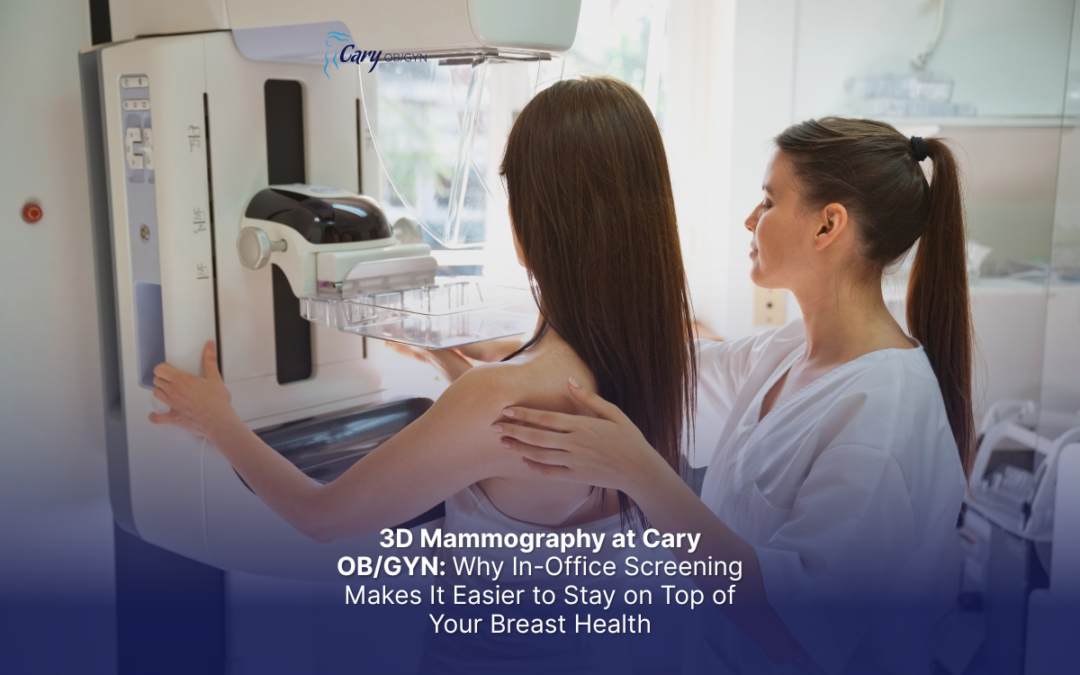
You will disrobe from the waist up and wear a gown for your mammogram. A highly trained technician performs the exam and will direct your movements throughout. You will stand next to the machine and remain still while your breast is gently compressed, and a camera captures a series of X-ray images as it moves across your breast tissue. The entire appointment moves quickly, and most women are finished within a matter of minutes.
If you are wondering about safety, mammograms use a very minimal amount of radiation, roughly equal to what you would naturally be exposed to over about seven weeks in your everyday surroundings. That small amount of exposure is well worth the valuable, potentially life-saving information a mammogram provides. And with the 3D exam requiring only a single compression to capture all of its detailed images, the process itself does not take any longer than a traditional mammogram would.
How to Prepare
Try to avoid scheduling your mammogram during your period, or in the week before and after, since breast tenderness and swelling tend to be more pronounced during that window. Shower or bathe before your appointment, but skip deodorant, antiperspirant, lotion, or powder, since these products can interfere with the imaging. If mammograms tend to be uncomfortable for you, taking an over the counter pain reliever beforehand can help. Wearing a two piece outfit also makes the whole process simpler, since you will only need to undress from the waist up.
|
“New doctor [Gilberto Rodrigo, MD, FACOG] for me and was pleased with the [breast] exam and taking time to describe what would happen next.”
Cary OB/GYN Patient Testimonial
|
One Trusted Place for Your Care
Because your mammogram happens in the same office as your regular gynecologic care, your OB/GYN, the provider who already knows your history and your risk factors, stays directly connected to your results. There is no separate facility working in isolation from the rest of your care, which means fewer gaps and fewer places for something to fall through the cracks.
If your results ever need a closer look, that connection matters even more. Instead of waiting on a report from an unfamiliar facility, you are talking directly with a provider who already understands your full health picture and can walk you through exactly what any finding means and what happens next.
Schedule Your Mammogram Today
Whether it has been a year or several since your last screening, there is no better time than now. Our team at Cary OB/GYN is ready to help. Contact us or book an appointment at our Cary or Morrisville office today.

by OB/GYN | Oct 3, 2024 | Mammogram, Women's Health
Breast Cancer Awareness Month is the perfect time to take charge of your breast health. At Cary OB/GYN, we want to empower you with the knowledge and tools to reduce your risk of breast cancer and detect any signs early. Use the checklist below to stay proactive about your breast health.
Prevention Checklist
- Maintain a Healthy Weight
☐ Aim to keep your weight within a healthy range, particularly after menopause, to lower your breast cancer risk.
- Exercise Regularly
☐ Incorporate at least 150 minutes of moderate exercise into your weekly routine. Staying active helps balance hormones and supports your overall health.
- Limit Alcohol Consumption
☐ Keep your alcohol intake to no more than one drink per day, as even small amounts can increase breast cancer risk.
- Don’t Smoke
☐ If you smoke, seek support to quit. Smoking is linked to many cancers, including breast cancer.
- Consider Breastfeeding
☐ If possible, breastfeeding for several months can slightly reduce your risk of breast cancer while offering benefits for your baby as well.
- Be Mindful of Hormone Replacement Therapy (HRT)
☐ Long-term HRT can increase your breast cancer risk. Speak with your OB/GYN to explore safer options for managing menopause symptoms.
- Eat a Nutritious Diet
☐ Focus on a diet rich in fruits, vegetables, lean proteins, and healthy fats to support overall health and reduce cancer risk.
Early Detection Checklist
- Perform Monthly Self-Breast Exams
☐ Get into the habit of performing a self-breast exam every month. This helps you become familiar with your breasts and detect any unusual changes.
- Schedule Regular Mammograms
☐ Start yearly mammograms at age 40, or earlier if you have a higher risk. Mammograms are one of the best tools for early detection of breast cancer.
- Know Your Family History
☐ Understanding your family history of breast or ovarian cancer can help your doctor assess your risk and recommend a personalized screening plan.
- Get Annual Clinical Breast Exams
☐ In addition to self-exams and mammograms, make sure to get a clinical breast exam during your annual OB/GYN visit. Your doctor can check for any abnormalities you might not notice on your own.
- Watch for Warning Signs
☐ Be alert for changes such as lumps, skin dimpling, nipple discharge, or persistent breast pain. Report any unusual symptoms to your healthcare provider immediately.
Stay Proactive with Your Breast Health
By following this checklist, you can reduce your breast cancer risk and ensure early detection. At Cary OB/GYN, we’re here to support you with compassionate care and expert guidance. If you’re due for a mammogram or have concerns about your breast health, contact our North Carolina office to schedule an appointment here.
Further Reading: breastcancer.org

by Marketing Manager | Oct 20, 2022 | Mammogram
[vc_row][vc_column][vc_column_text]Breast pain, lumps, swelling and abnormalities seen in mammograms have become a commonality for women after getting the COVID vaccine. Experts say to still continue to get your regularly scheduled mammogram.
COVID vaccinations were first released at the end of 2020 and are continuing to be developed and studied. One of the common side effects that started to arise in the beginning was the complaint of pain and lumps in the breast and underarm area after vaccination. This was very worrying to many people, especially women with concerns about breast cancer.
Researchers and healthcare providers found that the COVID vaccine was commonly causing lymph nodes in the armpit and breast region to become swollen and painful. This is referred to as axillary lymphadenopathy. Lumps in this area are known to be a sign of breast cancer. Luckily, it was concluded that the inflammation usually goes down within a few weeks and there was no breast cancer present.
There are no links between the COVID vaccine and breast cancer. Dr. Lisa Mullen, a radiologist who specializes in breast imaging told Johns Hopkins Medicine, “Lymph nodes under the arm where a person has gotten a vaccine can become enlarged as part of the normal immune response to the vaccine. The COVID-19 vaccine is a new type of vaccine, and people are reacting strongly to it. That heightened immune response is normal and expected.”1
People may ask themselves how this swelling and sometimes painful response can be a good thing. Remember that the lymph nodes are a part of the lymphatic system that helps filter the blood and aid in immunity. When someone gets sick, they often become swollen due to an immune response. Since the COVID vaccine stimulates the immune system, it is common for the lymph nodes to become swollen after getting the COVID vaccine. This is called an immunogenic reaction.
In the beginning, these lumps were leading to women having abnormal mammogram results. Dr. Edmonds started researching the correlation between abnormal mammograms and when the women were getting their COVID vaccines. Her team and others around the country found that most women had been vaccinated during the weeks leading up to their abnormal mammogram results. They found a correlation between which arm the women had been vaccinated in and which side of the mammogram was abnormal.
At first, the Society of Breast Imaging began recommending that women should wait four to six weeks after any COVID vaccines to have their mammogram completed to decrease the chance that swelling from the vaccination would cause abnormal mammogram results.
Since then, there has been more research conducted and in February 2022, the Society of Breast Imaging changed its recommendation to not delay mammograms due to COVID vaccination because these lumps can cause mammogram abnormalities for up to several months. Instead, women should proceed with their regularly scheduled mammograms.1 When going for the appointment let the mammogram technician performing the test know when you were vaccinated and in what arm so that they can document it for the radiologist.1
The key takeaway that women should remember is that getting swollen lymph nodes after the COVID vaccine is a normal response. Swelling usually goes down within a few weeks and the COVID vaccine does not cause breast cancer. Women should not delay their mammograms due to COVID vaccination. If you have more concerns or questions, reach out to your healthcare providers.
Resources
- Covid-19 vaccine: Can it affect your mammogram results? Johns Hopkins Medicine. (2022, May 18). Retrieved October 11, 2022
- The COVID-19 Vaccine Can Impact Mammograms. What You Should Do (and Why You Shouldn’t Worry!). Pennmedicine.org. (2022, September 29). Retrieved October 11, 2022
[/vc_column_text][/vc_column][/vc_row][vc_row css=”.vc_custom_1618658856512{margin-top: 75px !important;}”][vc_column][vc_text_separator title=”Services We Offer:”][vc_column_text]
Laparoscopy | Abnormal Bleeding | Menopause | Minimally Invasive Surgery | Contraception | Pap Smear | Pelvic Pain | Family Planning | STD Testing | Hormone Therapy | Hysterectomy | Infertility | 3D Mammography | Pregnancy & Prenatal Care | Preventive Screening
[/vc_column_text][vc_text_separator title=”Website Navigation:”][vc_column_text]
Home | About | OB Videos | Insurances Accepted | Blog | Providers | Michael Anthony, MD, FACOG | Noemi Maydew, MD, FACOG | Anne Bond Bonpain, MD, FACOG | Elita Wyckoff, MD, FACOG | Gilberto Rodrigo, MD, FACOG | Jennifer Fraley, MD, FACOG | Heather Flowers | Courtney Braswell | Services | Patient Care | Advanced Care Team | Testimonials | Contact Us | Patient Portal
[/vc_column_text][/vc_column][/vc_row]

by OB/GYN | Nov 21, 2021 | Mammogram, Women's Health
[vc_row][vc_column][vc_column_text]Topic: What Innovations Are Coming Down the Pike for Breast Cancer?
Innovations occur in medicine all the time. Some happen quickly, like the unprecedented speed with which the COVID-19 vaccines were developed. Others take more time to develop, as researchers leverage current knowledge and new ideas to develop novel pathways toward diagnosis, treatment, and survival for people with a wide variety of diseases.
Each column, we dive deeply into lab reports, journals, and conferences to bring you the most anticipated innovations coming down the pike for one of the most dreaded diseases: cancer. This round, our focus is on breast cancer. Among new developments to keep an eye on include:
Artificial Intelligence (AI) That May Allow for More Accurate Breast Cancer Screenings
A new AI tool may take breast cancer screenings to the next level by increasing radiologists’ accuracy when interpreting ultrasound images. Using a data set of more than five million images collected from 288,000 exams of roughly 143,000 patients, researchers have trained and validated an AI system to automatically identify malignant lesions in breast ultrasound images.
Findings from the study, which were published online in September 2021 in Nature Communications, show that the AI tool decreased the rate of false positives (samples erroneously categorized as positive) by 37.3 percent, significantly reducing the number of women referred for unnecessary biopsies.
Next Steps The tool isn’t quite ready for prime time, according to the researchers. More work is needed to further test its accuracy. They also plan to refine and personalize the tool to use patient-specific information (e.g., genetic history, family risk) to better inform evaluations and follow-ups.
Precision-Activated Cancer Therapeutics That Could Usher in a New Era in Therapy
Researchers have discovered a way to activate cancer therapies, such as the drug Adriamycin (doxorubicin), directly in tumors, thereby reducing side effects felt throughout the rest of the body. (Adriamycin has been notoriously nicknamed “the red devil” for its color and difficult side effects.) The technology involves giving an inactivated form of chemotherapy intravenously and injecting an activating agent directly into the tumor. This approach to therapy, known as CAPAC (Click Activated Protodrugs Against Cancer), keeps the toxic effects of the chemotherapy mostly contained inside the tumor, while sparing the rest of the body the worst of the side effects. CAPAC can also be used for other tumor types that are amenable to direct injection.
In the first study in which the technology was used in humans, the results, presented at the European Society for Medical Oncology Congress in mid-September, showed that levels of SQ3370 (equivalent to conventional doxorubicin) were 50 times higher in the tumor than in the bloodstream, with no serious adverse events that would require dosage adjustments. The small experimental trial included nine patients, eight of whom had metastatic cancer, including triple-negative breast cancer. Cancer progression stabilized in more than half of the patients treated with CAPAC, including those in whom the disease had progressed when treated with prior Adriamycin or other chemotherapy agents.
Topic Discussed: What Innovations Are Coming Down the Pike for Breast Cancer?
Read More[/vc_column_text][/vc_column][/vc_row][vc_row css=”.vc_custom_1618658856512{margin-top: 75px !important;}”][vc_column][vc_text_separator title=”Services We Offer:”][vc_column_text]
Laparoscopy | Abnormal Bleeding | Menopause | Minimally Invasive Surgery | Contraception | Pap Smear | Pelvic Pain | Family Planning | STD Testing | Hormone Therapy | Hysterectomy | Infertility | 3D Mammography | Pregnancy & Prenatal Care | Preventive Screening
[/vc_column_text][vc_text_separator title=”Website Navigation:”][vc_column_text]
Home | About | OB Videos | Insurances Accepted | Blog | Providers | Michael Anthony, MD, FACOG | Noemi Maydew, MD, FACOG | Anne Bond Bonpain, MD, FACOG | Elita Wyckoff, MD, FACOG | Gilberto Rodrigo, MD, FACOG | Jennifer Fraley, MD, FACOG | Heather Flowers | Courtney Braswell | Services | Patient Care | Advanced Care Team | Testimonials | Contact Us | Patient Portal
[/vc_column_text][/vc_column][/vc_row]

by OB/GYN | Nov 17, 2021 | Mammogram, Technology
[vc_row][vc_column][vc_column_text]Topic: This AI tool helps identifies breast cancer with 90% accuracy rate
An artificial intelligence tool—trained on roughly a million screening mammography images—can identify breast cancer with approximately 90% accuracy when combined with radiologist analysis, a new study finds.
The study examined the ability of a type of artificial intelligence (AI), a machine learning computer program, to add value to the diagnoses a group of 14 radiologists reached as they reviewed 720 mammogram images.
“Our study found that AI identified cancer-related patterns in the data that radiologists could not, and vice versa,” says senior study author Krzysztof Geras, assistant professor in the radiology department at New York University’s Grossman School of Medicine.
“AI detected pixel-level changes in tissue invisible to the human eye, while humans used forms of reasoning not available to AI,” adds Geras, also an affiliated faculty member at the Center for Data Science. “The ultimate goal of our work is to augment, not replace, human radiologists.”
In 2014, women (without symptoms) in the United States got more than 39 million mammography exams to screen for breast cancer and determine the need for closer follow-up. Women whose test results yield abnormal mammography findings are referred for biopsy, a procedure that removes a small sample of breast tissue for laboratory testing.
In the new study, the research team designed statistical techniques that let their program “learn” how to get better at a task without being told exactly how. Such programs build mathematical models that enable decision-making based on data examples fed into them, with the program getting “smarter” as it reviews more and more data.
Modern AI approaches, which take inspiration from the human brain, use complex circuits to process information in layers, with each step feeding information into the next, and assigning more or less importance to each piece of information along the way.
The authors of the current study trained their AI tool on many images matched with the results of biopsies performed in the past. Their goal was to enable the tool to help radiologists reduce the number of biopsies needed moving forward. This can only be achieved, says Geras, by increasing the confidence that physicians have in the accuracy of assessments made for screening exams (for example, reducing false-positive and false-negative results).
Topic Discussed: This AI tool helps identifies breast cancer with 90% accuracy rate
Read More[/vc_column_text][/vc_column][/vc_row][vc_row css=”.vc_custom_1618658856512{margin-top: 75px !important;}”][vc_column][vc_text_separator title=”Services We Offer:”][vc_column_text]
Laparoscopy | Abnormal Bleeding | Menopause | Minimally Invasive Surgery | Contraception | Pap Smear | Pelvic Pain | Family Planning | STD Testing | Hormone Therapy | Hysterectomy | Infertility | 3D Mammography | Pregnancy & Prenatal Care | Preventive Screening
[/vc_column_text][vc_text_separator title=”Website Navigation:”][vc_column_text]
Home | About | OB Videos | Insurances Accepted | Blog | Providers | Michael Anthony, MD, FACOG | Noemi Maydew, MD, FACOG | Anne Bond Bonpain, MD, FACOG | Elita Wyckoff, MD, FACOG | Gilberto Rodrigo, MD, FACOG | Jennifer Fraley, MD, FACOG | Heather Flowers | Courtney Braswell | Services | Patient Care | Advanced Care Team | Testimonials | Contact Us | Patient Portal
[/vc_column_text][/vc_column][/vc_row]

by OB/GYN | Oct 26, 2021 | Mammogram, OB/GYN News, Women's Health
[vc_row][vc_column][vc_column_text]Topic: When to Get a Mammogram
Expert groups often disagree with each other on breast cancer screening. CR makes sense of the different recommendations.
Every October marks Breast Cancer Awareness Month, which always brings a flurry of reminders to women to stay up to date with their mammograms: X-rays that help detect lesions in the breast that may signal cancer. After a year when—according to research by the Centers for Disease Control and Prevention—many people appeared to delay their routine screenings because of the COVID-19 pandemic, these reminders may feel particularly urgent.
But determining who actually needs a mammogram is not so straightforward. Cancer experts don’t agree on when women should begin to have this breast cancer screening test, or how often to do so.
For instance, the U.S. Preventive Services Task Force (USPSTF), an independent panel of medical experts that evaluates preventive medical services, says women at average breast cancer risk should start screenings at age 50.
But the American Cancer Society (ACS) recommends starting at 45, and the American College of Radiology (ACR) advises beginning at age 40.
And the American College of Obstetricians and Gynecologists (ACOG) says women should start screening no later than age 50 but with the choice to begin sooner.
Why the different advice? In part, it’s because these expert groups may evaluate scientific studies on mammography differently, some placing more weight on the benefits of mammography and some emphasizing the screening’s potential downsides, according to the American College of Physicians (ACP).
They may also differ in the types of studies they rely on or on how to grapple with issues of cost when writing screening recommendations.
The result: “Both patients and clinicians are frustrated and sometimes confused,” says Joann Elmore, MD, MPH, professor of medicine at the David Geffen School of Medicine at UCLA, and director for the UCLA National Clinician Scholars Program.
In addition, like all screening tests, mammograms themselves have their pros and cons.
Here, what to know about mammography, what the various recommendations may mean for you, and how to work with your doctor to make the best decision for yourself.
Topic Discussed: When to Get a Mammogram
Read More[/vc_column_text][/vc_column][/vc_row][vc_row css=”.vc_custom_1618658856512{margin-top: 75px !important;}”][vc_column][vc_text_separator title=”Services We Offer:”][vc_column_text]
Laparoscopy | Abnormal Bleeding | Menopause | Minimally Invasive Surgery | Contraception | Pap Smear | Pelvic Pain | Family Planning | STD Testing | Hormone Therapy | Hysterectomy | Infertility | 3D Mammography | Pregnancy & Prenatal Care | Preventive Screening
[/vc_column_text][vc_text_separator title=”Website Navigation:”][vc_column_text]
Home | About | OB Videos | Insurances Accepted | Blog | Providers | Michael Anthony, MD, FACOG | Noemi Maydew, MD, FACOG | Anne Bond Bonpain, MD, FACOG | Elita Wyckoff, MD, FACOG | Gilberto Rodrigo, MD, FACOG | Jennifer Fraley, MD, FACOG | Heather Flowers | Courtney Braswell | Services | Patient Care | Advanced Care Team | Testimonials | Contact Us | Patient Portal
[/vc_column_text][/vc_column][/vc_row]