by Marketing Manager | Mar 9, 2023 | Pregnancy, Women's Health
[vc_row][vc_column][vc_column_text]Being pregnant is a normal and healthy state of living but there are a lot of physical changes that take place. This leads to many questions about what is okay and what isn’t okay. A common question that comes up during pregnancy is if it is safe to travel or not. Read on to learn more about traveling while pregnant.
Is It Safe to Travel During Pregnancy?
In most cases, it is safe to travel during pregnancy but there are some things to keep in mind. Talk with your OB/GYN provider before you start planning a trip. If you have pregnancy complications, are close to your due date, or are at high risk, they will likely recommend not traveling.
What Are the Dangers of Traveling While Pregnant?
In most circumstances, it is safe to travel during pregnancy but you should be aware of signs of complications and know when to go to the hospital or get emergency medical care. Signs to look for include:
- Vaginal Bleeding
- Pelvic or Abdominal Pain
- Contractions
- Water Breaks
- Headache That Won’t Go Away
- Elevated Blood Pressure
- Signs of Preeclampsia
- Changes in Eyesight
- Swelling of the Face or Hands
- Severe Vomiting or Diarrhea
- Signs of a Blood Clot
Is It Safe to Fly During Pregnancy?
In a healthy pregnancy, it is safe to fly domestically until about 36 weeks of pregnancy. If traveling internationally, speak with your OB/GYN to see what they recommend. You shouldn’t fly if you have a medical condition that could be made worse by flying or that would require you to need emergency medical care.
Are There Places I Shouldn’t Go to If I’m Pregnant?
It is safe to travel to most places but you should consider if your destination has an adequate healthcare system in place in case you need care. Avoid places that have a high risk of zika or malaria.
What Should I Do Before Traveling While Pregnant?
The first thing you should do before making any travel arrangements is speak with your OB/GYN healthcare provider and discuss your plans. Make sure to plan ahead and check out what healthcare facilities are available at your destination. If you will be traveling overseas, check your healthcare policy for pregnancy and neonatal complications while in a foreign country. Make sure to check the pregnancy policies of any of the travel companies you will be using.[/vc_column_text][/vc_column][/vc_row][vc_row css=”.vc_custom_1618658856512{margin-top: 75px !important;}”][vc_column][vc_text_separator title=”Services We Offer:”][vc_column_text]
Laparoscopy | Abnormal Bleeding | Menopause | Minimally Invasive Surgery | Contraception | Pap Smear | Pelvic Pain | Family Planning | STD Testing | Hormone Therapy | Hysterectomy | Infertility | 3D Mammography | Pregnancy & Prenatal Care | Preventive Screening
[/vc_column_text][vc_text_separator title=”Website Navigation:”][vc_column_text]
Home | About | OB Videos | Insurances Accepted | Blog | Providers | Michael Anthony, MD, FACOG | Noemi Maydew, MD, FACOG | Anne Bond Bonpain, MD, FACOG | Elita Wyckoff, MD, FACOG | Gilberto Rodrigo, MD, FACOG | Jennifer Fraley, MD, FACOG | Heather Flowers | Courtney Braswell | Services | Patient Care | Advanced Care Team | Testimonials | Contact Us | Patient Portal
[/vc_column_text][/vc_column][/vc_row]

by Marketing Manager | Feb 9, 2023 | Pregnancy, Women's Health
[vc_row][vc_column][vc_column_text]One of the big questions you may face if you are pregnant or thinking of becoming pregnant is the use of medication. Many people take medication daily to stay healthy but not all medications are considered safe to take during pregnancy. Some medications are known to possibly cause pregnancy complications, miscarriage, birth defects, premature birth, or developmental disabilities. Read on to learn more about medication and pregnancy.
Medication Use During Pregnancy
The truth is that the medical field does not have that much information on the effects of many medications during pregnancy because pregnant women are not usually included in medication safety trials. According to the Centers for Disease Control and Prevention (CDC), what we do know about medicine use in pregnancy is:
- 9 in 10 women use medicine during pregnancy, and 7 in 10 of those women report taking at least one prescription medication
- Many women need to take medication during their pregnancy to manage their health conditions
- Sometimes, avoiding or stopping the use of a medication during pregnancy could be more harmful than taking the medication during pregnancy
- Some medications increase the risk of pregnancy complications, miscarriage, birth defects, premature birth, or developmental disabilities
- There are several factors to consider such as medical history, current health status, the dosage of the medication, and possible side effects of the medication
What Should I Do About My Medications If I Am Pregnant or Thinking Of Becoming Pregnant?
The first thing you should do if you are pregnant, trying to become pregnant, or thinking of becoming pregnant is talk to your healthcare provider. You should always talk to your healthcare provider before starting or stopping any medications. Make sure to discuss every medication you take including prescriptions, over-the-counter medication, supplements, and vitamins. If you do have health conditions that you take medication for, talk with your healthcare provider about the best ways to manage your condition during pregnancy. The key to managing medication concerns during pregnancy is to talk with your healthcare provider about them.
Resources
- Centers for Disease Control and Prevention. (2022, September 20). Pregnant or thinking of getting pregnant? Centers for Disease Control and Prevention. Retrieved February 2, 2023
[/vc_column_text][/vc_column][/vc_row][vc_row css=”.vc_custom_1618658856512{margin-top: 75px !important;}”][vc_column][vc_text_separator title=”Services We Offer:”][vc_column_text]
Laparoscopy | Abnormal Bleeding | Menopause | Minimally Invasive Surgery | Contraception | Pap Smear | Pelvic Pain | Family Planning | STD Testing | Hormone Therapy | Hysterectomy | Infertility | 3D Mammography | Pregnancy & Prenatal Care | Preventive Screening
[/vc_column_text][vc_text_separator title=”Website Navigation:”][vc_column_text]
Home | About | OB Videos | Insurances Accepted | Blog | Providers | Michael Anthony, MD, FACOG | Noemi Maydew, MD, FACOG | Anne Bond Bonpain, MD, FACOG | Elita Wyckoff, MD, FACOG | Gilberto Rodrigo, MD, FACOG | Jennifer Fraley, MD, FACOG | Heather Flowers | Courtney Braswell | Services | Patient Care | Advanced Care Team | Testimonials | Contact Us | Patient Portal
[/vc_column_text][/vc_column][/vc_row]
by Marketing Manager | Feb 2, 2023 | Pregnancy, Women's Health
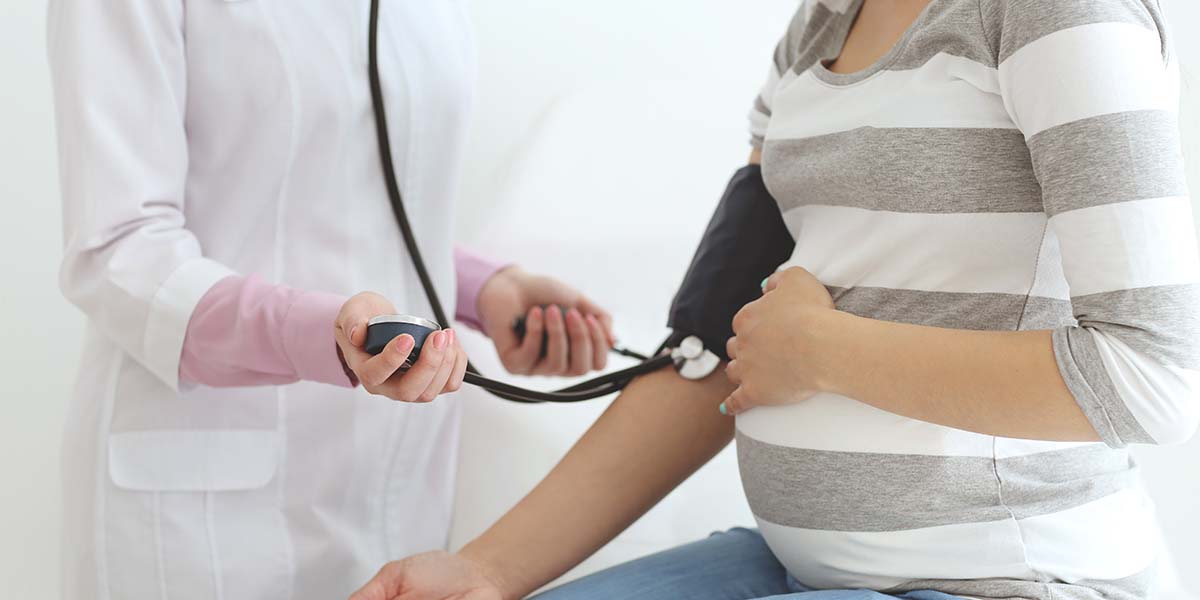
[vc_row][vc_column][vc_column_text]Most people are familiar with the medical condition referred to as hypertension or high blood pressure. Having high blood pressure during pregnancy may lead to the pregnancy condition known as pre-eclampsia. This condition is characterized by two main symptoms, high blood pressure and protein present in the urine. Pre-eclampsia is dangerous and can lead to serious complications for mother and baby, and possibly even death. This is one of the reasons that your OB/GYN healthcare provider checks your blood pressure every time you come in for an appointment. It is important for them to monitor any changes and possible signs they see of pre-eclampsia so that it can be diagnosed and treated as early as possible. According to the National Library of Medicine, pre-eclampsia is related to 2% to 8% of pregnancy complications and is responsible for 50,000 maternal deaths and over 500,000 fetal deaths worldwide.1
Recently there has been new information emerging about pre-eclampsia. A research team published an article about the long-term effects of pre-eclampsia on women in the European Journal of Preventive Cardiology. The researchers found that women who had pre-eclampsia during pregnancy are at a greater risk of having a heart attack or stroke in the future.2
In this study, the researchers analyzed national registers in Denmark from 1978 to 2017, which included more than 1.1 million women who experienced pre-eclampsia with no prior history of having high blood pressure. Then the researchers followed up with these women and found some interesting trends. They found that up to 2% of the women with pre-eclampsia in their first pregnancy had a heart attack or stroke within twenty years of giving birth compared to only 1.2% of women not affected by pre-eclampsia. It was also found that women with pre-eclampsia were four times more likely to have a heart attack and three times more likely to have a stroke within 10 years of delivery compared to women not affected by pre-eclampsia.2
Lead researcher Dr. Sara Hallum, told U.S. News and World Report, “The high risk of cardiovascular disease after pre-eclampsia manifests at young ages and early after delivery. This indicates that interventions to prevent heart attacks and strokes in affected women cannot wait until middle age when they become eligible for conventional cardiovascular screening programs.”2
The bottom line is that prevention and early detection is key. Regularly monitor blood pressure before and after becoming pregnant. While pregnant, attend all of your doctor’s appointments so that they can monitor and detect any changes early. If you are diagnosed with preeclampsia, follow your healthcare provider’s instructions.
Resources
- Preeclampsia – statpearls – NCBI bookshelf. (n.d.). Retrieved January 26, 2023
- Murez, C. (2023, January 26). Preeclampsia in pregnancy is a bad sign for women’s Future Heart Health. Retrieved January 26, 2023
[/vc_column_text][/vc_column][/vc_row][vc_row css=”.vc_custom_1618658856512{margin-top: 75px !important;}”][vc_column][vc_text_separator title=”Services We Offer:”][vc_column_text]
Laparoscopy | Abnormal Bleeding | Menopause | Minimally Invasive Surgery | Contraception | Pap Smear | Pelvic Pain | Family Planning | STD Testing | Hormone Therapy | Hysterectomy | Infertility | 3D Mammography | Pregnancy & Prenatal Care | Preventive Screening
[/vc_column_text][vc_text_separator title=”Website Navigation:”][vc_column_text]
Home | About | OB Videos | Insurances Accepted | Blog | Providers | Michael Anthony, MD, FACOG | Noemi Maydew, MD, FACOG | Anne Bond Bonpain, MD, FACOG | Elita Wyckoff, MD, FACOG | Gilberto Rodrigo, MD, FACOG | Jennifer Fraley, MD, FACOG | Heather Flowers | Courtney Braswell | Services | Patient Care | Advanced Care Team | Testimonials | Contact Us | Patient Portal
[/vc_column_text][/vc_column][/vc_row]

by Marketing Manager | Jan 5, 2023 | Women's Health
[vc_row][vc_column][vc_column_text]Women are more likely than men to have uncommon symptoms of a heart attack and a silent heart attack.
The typical image that plays in a person’s mind when they think of a heart attack may look something like someone clutching their chest, grasping, and crumbling over, but this is not always the case, especially when it comes to women. Heart disease is the number one killer of women in the United States yet their symptoms are often ignored. Frequently, the signs and symptoms of an oncoming or currently occurring woman’s heart attack are written off as something else or disregarded. Often, women can have more subtle signs of a heart attack. Read on to learn more about the signs a woman may experience during a heart attack.
Chest Pain or Discomfort
The most common heart attack symptom for both men and women is chest pain or discomfort. The pain could range from mild to strong. The pain could be consistent or intermittent. Any chest pain or discomfort should be taken seriously and not ignored.
Other Symptoms That May Be Experienced
Women are more likely than men to have symptoms other than chest pain. They are also more likely to have heart attacks that do not have obvious signs, these are referred to as silent heart attacks. These symptoms may include:
- Pain in the back, neck, jaw, or throat
- Shortness of breath
- Nausea
- Vomiting
- Indigestion
- Heartburn
- Fatigue
What You Should Do If You Think You Are Having a Heart Attack
If you think you or someone else is having a heart attack, you should not hesitate to get emergency medical care. Time is of the essence and if symptoms are ignored it could lead to permanent damage or even death. You should call 911 instead of driving yourself or having someone else drive you to the hospital. The ambulance personnel are trained to treat you on your way to the hospital. This is especially important if you live a long distance from a hospital. Learn the signs and symptoms of a heart attack so you are prepared if one ever occurs.
Resources
- Heart attack symptoms. Heart attack symptoms | Office on Women’s Health. (n.d.). Retrieved December 29, 2022
[/vc_column_text][/vc_column][/vc_row][vc_row css=”.vc_custom_1618658856512{margin-top: 75px !important;}”][vc_column][vc_text_separator title=”Services We Offer:”][vc_column_text]
Laparoscopy | Abnormal Bleeding | Menopause | Minimally Invasive Surgery | Contraception | Pap Smear | Pelvic Pain | Family Planning | STD Testing | Hormone Therapy | Hysterectomy | Infertility | 3D Mammography | Pregnancy & Prenatal Care | Preventive Screening
[/vc_column_text][vc_text_separator title=”Website Navigation:”][vc_column_text]
Home | About | OB Videos | Insurances Accepted | Blog | Providers | Michael Anthony, MD, FACOG | Noemi Maydew, MD, FACOG | Anne Bond Bonpain, MD, FACOG | Elita Wyckoff, MD, FACOG | Gilberto Rodrigo, MD, FACOG | Jennifer Fraley, MD, FACOG | Heather Flowers | Courtney Braswell | Services | Patient Care | Advanced Care Team | Testimonials | Contact Us | Patient Portal
[/vc_column_text][/vc_column][/vc_row]

by Marketing Manager | Dec 15, 2022 | Women's Health
[vc_row][vc_column][vc_column_text]Some people are a little weirded out when they first learn what a menstrual cup is. It might sound a little strange since our society is so used to tampons and pads. It is theorized that the first menstrual cup product was invented in the 1930s but did not gain much popularity until now. Menstrual cups have evolved since then and become more user friendly and less taboo which is helping them rise in popularity.
For those of you who have not heard of a menstrual cup, it is a small flexible cup made from silicone, rubber, latex, or thermoplastics. It is inserted into the vagina during menstruation and it catches and collects the blood. If you are new to menstrual cups, you may have a lot of questions but it really is as simple as a flexible cup that collects your period blood. Since they have been growing in popularity, there are now different shapes and sizes available. The cups can hold more fluid than a tampon. The frequency that you have to empty the cup will depend on the size of the cup and how heavy your flow is. On average a menstrual cup can be worn for up to twelve hours.
Women have been growing fond of menstrual cups for many reasons including:
- They are more comfortable than the standard tampon or pad
- More user friendly for physical or long activities
- Less odor
- Ability to wear it for a longer period of time than a pad or tampon
- More environmentally friendly
- Cost savings
Many women find the menstrual cup more comfortable than a pad or tampon and easier for sports and activities. Depending on the size of the cup and the rate of menstrual flow the cup can be worn for up to twelve hours. No more forgetting a tampon and then having to ask around for one. No more having to dig for tampons or pads at the bottom of a purse. Menstrual cups are reusable which makes them more cost-efficient and environmentally friendly.
There are some downsides to menstrual cups to consider. At first, it may be difficult to learn how to put the menstrual cup in and take it out of the vagina. Since there are different shapes and sizes it may take some trial and error before a woman finds the right one for her. Sometimes emptying the cup can be a little messy when first learning how to use it. The menstrual cup should be sterilized between periods which can usually be done by placing it in boiling water. Whether the menstrual cup is a good option for you is your choice but it is good to know that there is an alternative to pads and tampons and there are many women who are taking the plunge.
Resources
- Mayo Foundation for Medical Education and Research. (2022, October 27). Mayo Clinic Q and a: Menstrual cups – why the recent increase in popularity? – mayo clinic news network. Mayo Clinic. Retrieved December 11, 2022
[/vc_column_text][/vc_column][/vc_row][vc_row css=”.vc_custom_1618658856512{margin-top: 75px !important;}”][vc_column][vc_text_separator title=”Services We Offer:”][vc_column_text]
Laparoscopy | Abnormal Bleeding | Menopause | Minimally Invasive Surgery | Contraception | Pap Smear | Pelvic Pain | Family Planning | STD Testing | Hormone Therapy | Hysterectomy | Infertility | 3D Mammography | Pregnancy & Prenatal Care | Preventive Screening
[/vc_column_text][vc_text_separator title=”Website Navigation:”][vc_column_text]
Home | About | OB Videos | Insurances Accepted | Blog | Providers | Michael Anthony, MD, FACOG | Noemi Maydew, MD, FACOG | Anne Bond Bonpain, MD, FACOG | Elita Wyckoff, MD, FACOG | Gilberto Rodrigo, MD, FACOG | Jennifer Fraley, MD, FACOG | Heather Flowers | Courtney Braswell | Services | Patient Care | Advanced Care Team | Testimonials | Contact Us | Patient Portal
[/vc_column_text][/vc_column][/vc_row]

by Marketing Manager | Dec 8, 2022 | Women's Health
[vc_row][vc_column][vc_column_text]There are several issues that females can experience related to their period. An issue that you may experience related to your menstrual cycle is missing periods. The medical term for missing periods that are not related to menopause is amenorrhea. You are considered to have amenorrhea if you haven’t had a period for three consecutive months or haven’t had your first period by the age of fifteen years old.
Causes of Amenorrhea
Pregnancy
Pregnancy is the most common cause of missed periods. When you are pregnant your periods stop because your ovaries are not releasing eggs and your uterus is carrying a fetus. Ceasing to have a period is a sign of pregnancy. It is normal and expected to not have a period while pregnant.
Breastfeeding
Many women do not have periods while they are breastfeeding. It is normal and expected to not have a period while breastfeeding. It is important to know that you can still become pregnant while breastfeeding. If you do not want to become pregnant you must use a method of birth control while breastfeeding.
Weight
Being under or over a healthy body weight can cause irregular or missed periods. Also, eating disorders can cause body fat to drop so low that ovulation stops. Periods will be irregular or stop all together.
Hormonal Imbalances
There are several medical conditions and disorders that can cause hormonal imbalances. Hormones are highly involved in the menstrual cycle. When hormones are imbalanced it can cause irregular and / or missed periods.
Severe Stress
Severe chronic stress can cause menstrual cycle issues and missing periods. Stress causes the hormone cortisol to increase which can cause period issues.
Medications
Some medications could cause irregularities in your period or missed periods. If you believe this may be the case, speak with the healthcare provider who is prescribing the medication.
What To Do About Missing Periods
If you are missing periods contact your gynecological healthcare provider. They will examine you, ask you questions, and order any testing needed to find the cause of your missed periods.
Resources
- Period problems. Period problems | Office on Women’s Health. (n.d.). Retrieved November 25, 2022
[/vc_column_text][/vc_column][/vc_row][vc_row css=”.vc_custom_1618658856512{margin-top: 75px !important;}”][vc_column][vc_text_separator title=”Services We Offer:”][vc_column_text]
Laparoscopy | Abnormal Bleeding | Menopause | Minimally Invasive Surgery | Contraception | Pap Smear | Pelvic Pain | Family Planning | STD Testing | Hormone Therapy | Hysterectomy | Infertility | 3D Mammography | Pregnancy & Prenatal Care | Preventive Screening
[/vc_column_text][vc_text_separator title=”Website Navigation:”][vc_column_text]
Home | About | OB Videos | Insurances Accepted | Blog | Providers | Michael Anthony, MD, FACOG | Noemi Maydew, MD, FACOG | Anne Bond Bonpain, MD, FACOG | Elita Wyckoff, MD, FACOG | Gilberto Rodrigo, MD, FACOG | Jennifer Fraley, MD, FACOG | Heather Flowers | Courtney Braswell | Services | Patient Care | Advanced Care Team | Testimonials | Contact Us | Patient Portal
[/vc_column_text][/vc_column][/vc_row]